
Institutional Durability and the Leadership Blind Spot
Institutions rarely fail suddenly—they fail by missing the moment to adapt. Leadership blind spots often delay renewal until it’s too late.
Apr 22
/
Ken Knueven
Most institutions recognize the need for renewal too late.
Across industries, disruption rarely appears dramatic when it begins. It often looks like a slower, cheaper, or less capable alternative, until suddenly it isn’t.
Innovation tends to follow what economists describe as an S-curve. New technology emerges slowly, improves gradually, and eventually accelerates into widespread adoption. For long periods, the dominant system appears stable and durable. Then a new curve begins to rise beneath it.
The Pattern of Disruption
History provides many examples. At the beginning of the twentieth century, horses were the dominant mode of transportation. Cities were designed around them. Entire industries supported their care, feeding, and infrastructure. Few people imagined that this deeply embedded system would disappear within a generation.
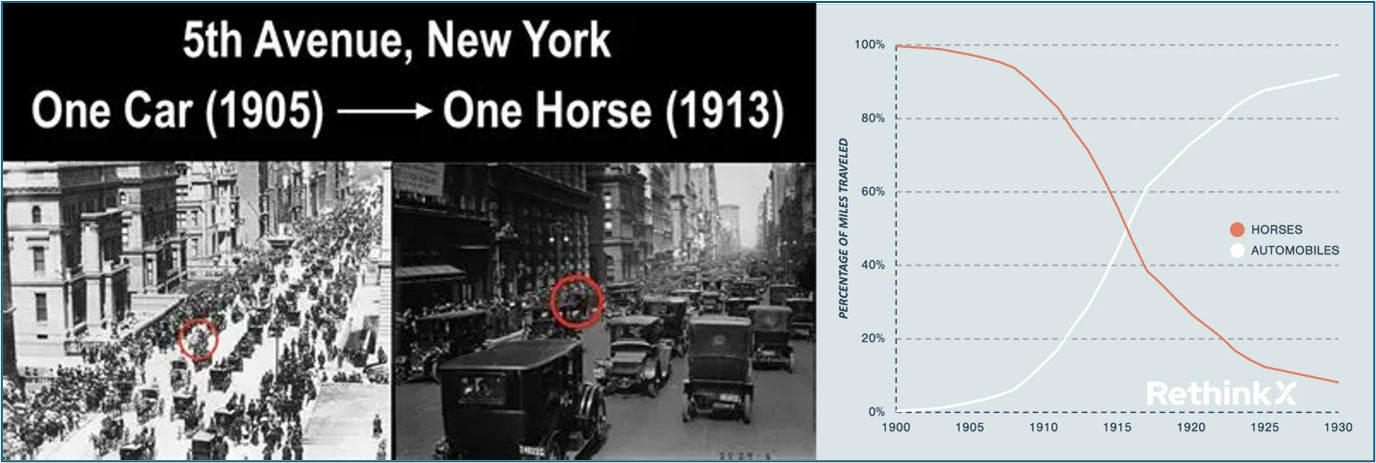
Yet within roughly three decades, the automobile reshaped transportation almost entirely. The transition did not occur overnight, but once the new curve accelerated, the change proved irreversible.
The same pattern has repeated across industries: film to digital cameras, physical media to streaming, coal to natural gas.
Disruption rarely happens suddenly.
Instead, one curve quietly overtakes another.
The Leadership Blind Spot
Leadership blind spots are not confined to distant history.
A modern example unfolded during the rise of the smartphone. In the mid-2000s, the dominant players in mobile technology were BlackBerry, Nokia, and even Microsoft. When Apple introduced the iPhone in 2007, many industry leaders dismissed it. Hundreds of billions of dollars in market valuation evaporated at these
Some of the most widely cited executive comments captured in disruption research include statements such as:
| “The iPhone is not a serious competitor.” | New Hampshire College, with 900 students, is not a serious competitor (now Southern New Hampshire University with +200,000 students) |
| “There’s no chance the iPhone will get significant market share.” | Online education will never be that popular |
Other industries weren’t immune either:
| “We do not believe our vendors selling products directly on Amazon is an imminent threat." | Everyone values face-to-face instruction because it is of higher quality |
| “Netflix isn’t even on the radar screen in terms of competition.” | AI will never replace faculty and take over education |
At the time, these were executives leading some of the world’s most successful technology firms.
They could not see or would not take seriously the new curve forming beneath the existing one.
What makes these examples striking is not that leaders were incompetent, but what makes an organization successful in the past does not guarantee it will be in the future.
But success can create a powerful form of blindness.
When institutions operate at the peak of a successful curve, it becomes difficult to recognize when the next one begins.
Higher Education’s Emerging Curve
Higher education institutions are now confronting a similar dynamic.
Individually, these pressures may appear manageable.
The pressures building across the sector are not confined to a single issue. They include:
- Declining demand for a college degree
- Demographic shifts
- Structural deficits are growing
- Evolving alternative credential models
- The emergence of AI for learning
- Evolving workforce expectations
- The big are getting bigger and taking market share
- Technology demands are outpacing institution’s ability to respond
Individually, these pressures may appear manageable.
Together, they suggest that the institutional environment has already entered a new curve of change. This raises an important question for boards and presidents alike:
How much renewal is required to be a prosperous institution?
The amount of renewal required is significantly greater than “institutional will and resolve”. This becomes a strategic issue for the board of trustees. The strongest institutions rarely wait for visible decline before they begin adapting. They recognize the moment when renewal must begin, even when the current model still appears successful.
The Institutional Renewal Curve
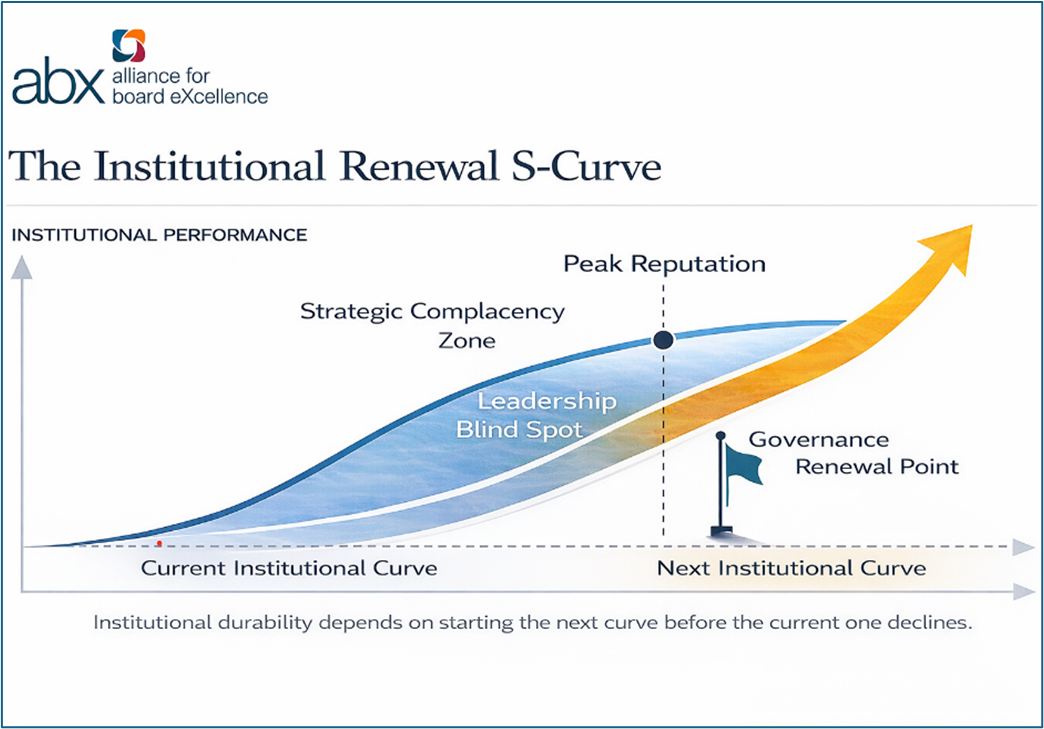
The concept can be illustrated through what might be called the Institutional Renewal Curve.
At the peak of reputation and institutional strength, leadership often encounters a leadership blind spot. Past success reinforces the belief that existing structures will continue to perform as they always have.
Yet it is precisely at this moment that renewal becomes the most critical. Organizations that wait too long to address challenges may discover that their ability to adapt and evolve has already begun to weaken, making transformation more difficult.
Institutional durability, therefore, depends not only on strategy or reputation. It depends on the timing of governance decisions.
Governance, Administration, and Renewal
For many institutions, the path to renewal also intersects with natural frameworks that include safeguards of the institutional mission and historical legacy. But these two important areas cannot be the reason for non-action.
As the pace of technological and economic change accelerates, the conversation increasingly becomes a shared one, among institutional leaders and governing boards, about how renewal can occur while preserving the mission values that defines an institution.
The Operating Challenge
And this is where the challenge becomes particularly complex.
Transitions between institutional curves are rarely solved through strategy documents alone. They require changes in governance approach, cadence, capital, operating models, financial architecture, and institutional partnerships that enable leadership teams to execute meaningful transformation.
Traditional approaches, or the old playbook, have lacked a focus on execution, capital, accountability, and doing things differently, not better.
But S-curve transitions are rarely strategic-only problems.
They are operating challenges.
Frameworks designed to optimize yesterday’s institutions rarely help leaders build tomorrow’s.
Many are wired for slow and incremental change, designed for a more stable industry structure.
They were not designed to help institutions rethink the systems themselves.
Institutional Durability
For institutions confronting these dynamics, the challenge may therefore be less using an old playbook to solve new challenges and a deep understanding of the structural financial challenges facing an institution.
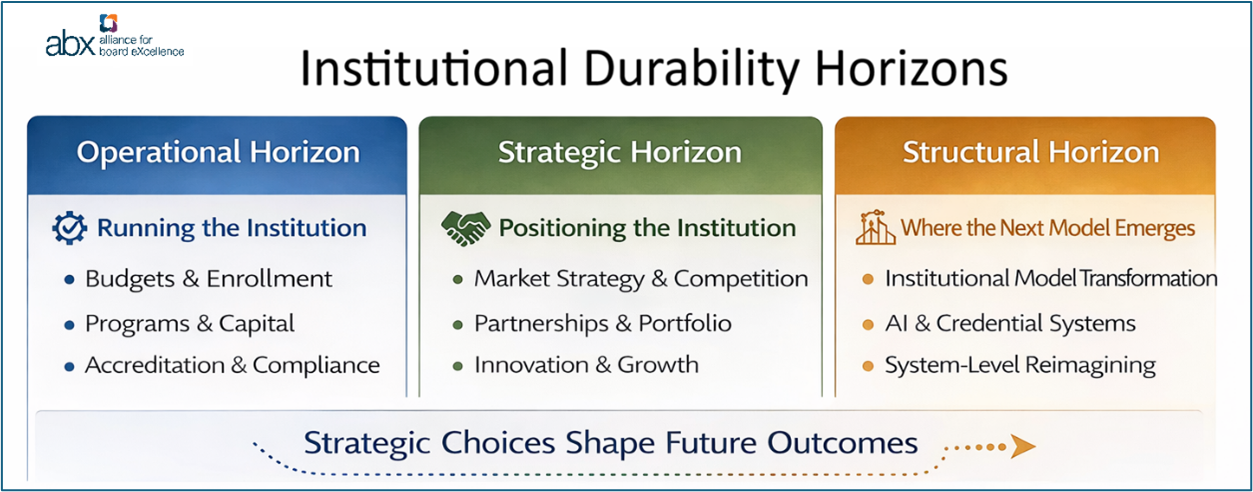
The future of institutional durability may depend less on the strength of past reputation and more on whether board leadership recognizes the moment when renewal must begin and whether they have the right governance mindset required to move confidently to the next curve.
These are precisely the kinds of questions the Alliance for Board eXcellence (ABX) focuses on.
Ultimately, institutional durability emerges from three forces working together: governance velocity, margin architecture, and the ability to recognize when renewal must begin.
And these forces do not simply add together.
They multiply.
An institution may have strong governance, but without a financial margin, the capacity to transform disappears. Another institution may have financial strength, but slow governance can prevent it from recognizing the next curve. And even institutions with both governance and resources can falter if renewal begins too late.
In simple terms:
Institutional Durability = Governance Velocity × Margin Architecture × Renewal Timing
When these three forces align, institutions gain the ability not only to survive periods of disruption but to shape the next curve themselves.

Copyright © 2026